

HUGH GRECIAN WILLIAMS 1773-1829 'WINDSOR CASTLE FROM THE RIVER' 1818 WATERCOLOUR
Couldn't load pickup availability
Hugh William (Grecian) Williams 1773 - 1829
Windsor Castle from the River
Watercolour on Paper signed and dated at bottom left.
53cm x 70cm Frame
36cm x 50cm Image
This is a superb early 19th century large watercolour by one of the best known watercolour artists of the late18th/early 19th century, Hugh William (Grecian) Williams who lived from 1773 until 1829.
The painting is a fantastic view of Windsor Castle from the river and features a man with a boy and his donkey.
The painting is signed at bottom left and is dated (we think) 1818, the date is slightly obscured.
Large scale views of known monuments do not come to the market often and usually command a premium price.
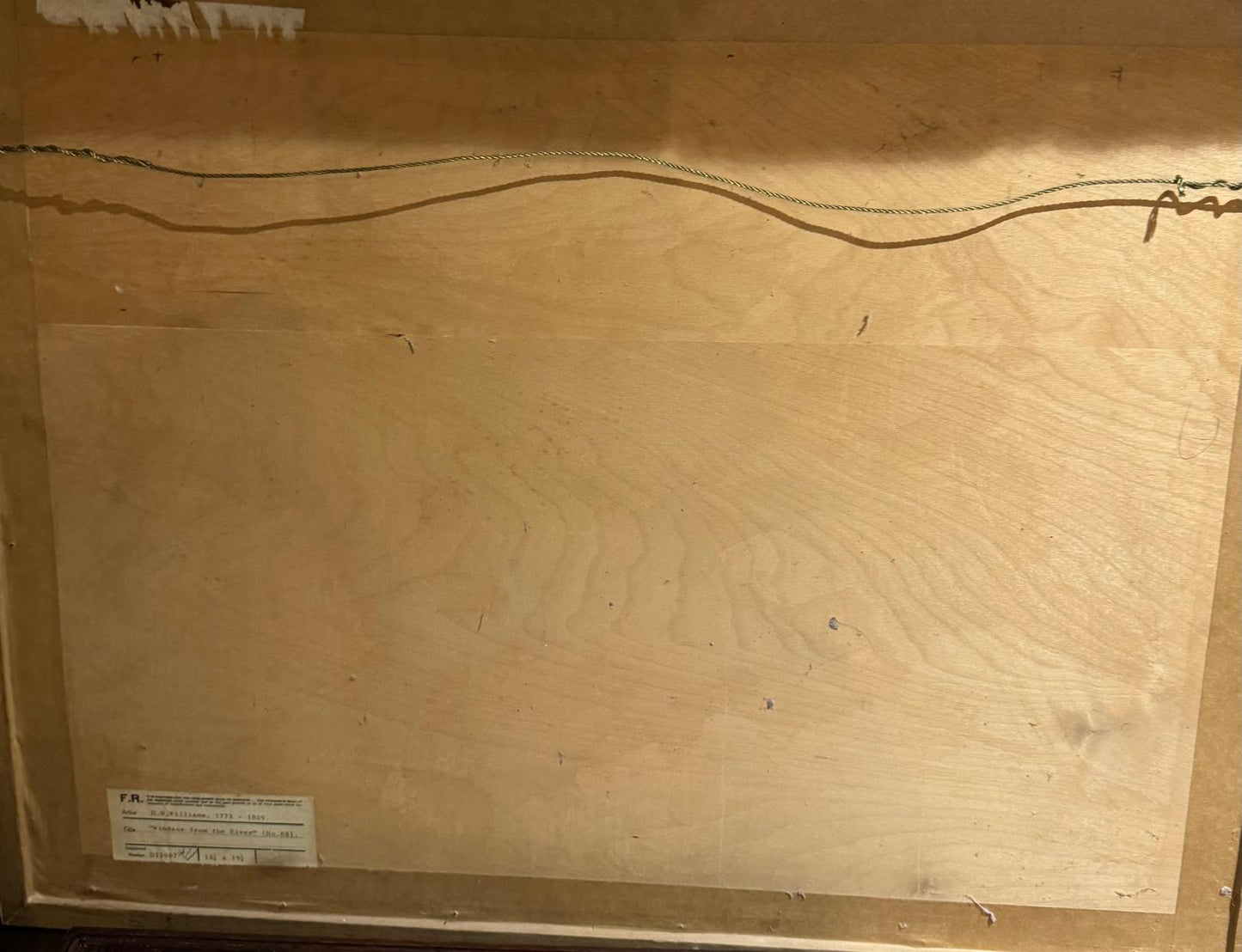
The painting is in very good condition overall and is housed in a c1950s glazed frame with a exhibition label on the reverse.
Hugh William Williams FRSE, known as "Grecian Williams," was a Scottish landscape painter.
Williams was born onboard the ship of his father, Captain Williams, whilst en route to the West Indies. His mother, "Miss Lewis", died in 1782, and his father, being unable to care for the nine-year-old Hugh, left him in the care of Louis Ruffini, a textile manufacturer in Dalkeith. Ruffini encouraged Hugh to become a painter. For some years he concentrated on Highland landscapes.
An extended tour in Italy and Greece, from which he returned in 1818, was funded by the then-recently unseated Member of Parliament William Douglas, an amateur artist, who also accompanied him. The tour gave his work its particular character, and earned him the nickname "Grecian Williams". In 1822 Williams held an exhibition of watercolours, based on his tour. It was a critical success, its ruins and famous scenes of Greek history chiming with the taste of the time.
Williams was an original member of the Associated Artists in Watercolour (1808), with Andrew Wilson, which was short-lived; and an associate of the Royal Institution, Edinburgh. Towards the end of his life he took an interest in the proposed amalgamation of the Scottish Academy and the artist associates of the Institution, an arrangement which was completed a month after his death.
He was elected a Fellow of the Royal Society of Edinburgh in 1823 his proposer being Sir David Brewster.
He died at home, 65 Castle Street in Edinburgh's First New Town on 23 June 1829. He is buried in Canongate Kirkyard in the lair of his in-laws, the Millars of Earnock
We guarantee the authenticity of our listings and offer a full money back guarantee if not as stated.