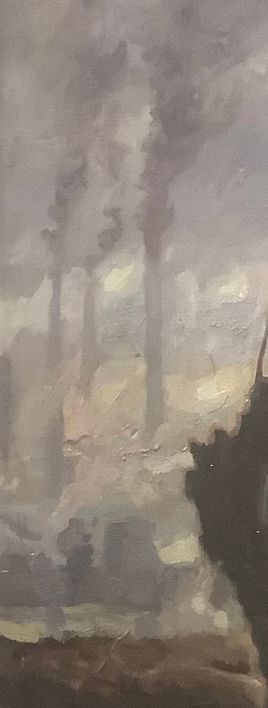


FRITZ GARTNER 1882 - 1958 GERMAN LANDSCAPE WITH CHIMNEYS AND PLOUGHING OIL ON CANVAS C1920
Impossibile caricare la disponibilità di ritiro
Fritz Gärtner (1882–1958)
Behind the Plough in an Industrial Landscape (c1920)
Oil on Canvas signed at bottom left
60cm x 72cm
This is a superb example of the work the German painter Freidrich 'Fritz' Gärtner who specialized in depicting the changing face of Germany as industrial power overtook manual labour. This painting seems to be a fresh take on his 1918 painting also called 'Behind the Plough in an Industrial Landscape' which is held in the Museum of Bread and Art (Museum Brot und Kunst ) in Ulm Germany.
The painting is unframed and could do with a light clean but is an important painting from this ground breaking German artist.
We guarantee the authenticity of all the paintings we sell with a full money back if not as stated.
We use a trackable and signed for service for Domestic and international buyers, to ensure the item reaches you securely and quickly.
Gärtner received his first artistic training from the painter Josef Reiner in his hometown of Aussig.
In 1900, he enrolled at the Academy of Fine Arts in Munich, studying first in the natural drawing class under Gabriel von Hackl.
Later he studied with several notable teachers, including Ludwig von Löfftz, Carl von Marr, Alexander Wagner, and Peter Halm.
Artistic Career
During the early 20th century, Gärtner spent several years in the Rhenish-Westphalian industrial region, one of Germany’s major steel and mining areas.
He worked in a studio located on the estate of the banker Hans Jordan, at Schloss Mallinckrodt.
In his later life, he lived and worked mainly in Munich, where he continued painting and exhibiting.
Although primarily a painter, he also worked as a graphic artist, illustrator, and occasionally as a sculptor and medallist.
Themes and Artistic Style
Gärtner is known for his focus on the world of labour—depicting farmers, industrial workers, factories, mines, and the relationship between people and the modern industrial landscape. His style blends Realism with Impressionist influences, with a later tendency toward monumental, large-scale compositions.
One of his artistic inspirations was the French Realist Jean-François Millet, known for his depictions of rural labour.
He was a member of both the Munich Secession and the German Artists’ Association (Deutscher Künstlerbund).
His works were displayed in the gallery of Heinrich Thannhauser, one of Munich’s most notable art dealers of the early 20th century.
Selected Works in Public Collections
Der Hochofen (The Blast Furnace), ca. 1918 – Deutsches Museum, Munich
Erntetage an der Ruhr (Harvest Days on the Ruhr), 1910 – DASA Working World Exhibition, Dortmund
Industrielandschaft (Industrial Landscape), 1929 – DASA, Dortmund
Brot und Eisen (Bread and Iron), ca. 1920 – Museum Brot und Kunst, Ulm
Legacy
Fritz Gärtner occupies an important place among the German artists who documented the transformation of society through industrialization. His paintings combine human labor, technology, and landscape with a sensitivity to both tradition and modernity. Through his exhibitions, awards, and professional associations, he became a respected figure in the German art scene of his time.