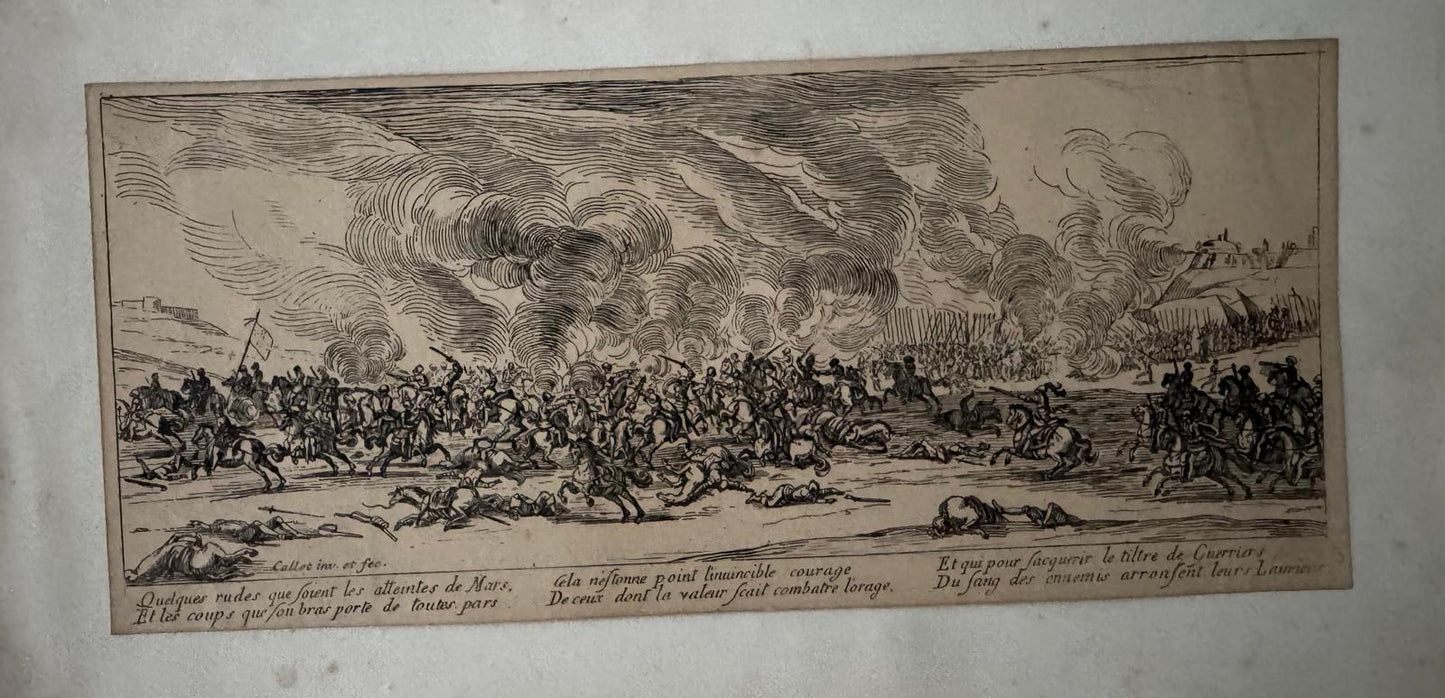


CALLOT, Jacques (1592-1635).Les Grandes Misères de la Guerre (The Miseries and Misfortunes of War).
Prezzo di listino
€422,95 EUR
Prezzo di listino
Prezzo di vendita
€422,95 EUR
Prezzo unitario
per
Imposte incluse.
Impossibile caricare la disponibilità di ritiro
CALLOT, Jacques (1592-1635). Les Grandes Misères de la Guerre
(The Miseries and Misfortunes of War).
Paris: Israël Henriet, 1633.
14 of the suite of 18 etchings Including Title
8.8cm x 19cm
Probably a third states but all with the Callot name at left side, tipped onto backing sheets and trimmed right up to the margins.
Besides the presence of the six verses by Abbé de Marolles, arranged in pairs below each etching and which are absent from the first state, Henriet's name appears on each of the eighteen engravings of the second state, whereas it has been omitted from the third and last known state and on that basis we think this may be the third state.
The fact that the series bears the date Paris (and not Nancy) 1633 is because the prints were made by the artist's compatriot and friend, Israël Henriet, who had held the exclusive rights to publish Callot's works since 1629 and was based in Paris.
Trained in painting and engraving from the age of 12 in Italy, initially during a runaway trip, Jacques Callot, with his family's consent, entered the service of the Medici in 1612, where he acquired a great reputation. He returned to Nancy in 1621 at the request of Charles IV, Duke of Lorraine.
He created this very famous series, often called "The Great Miseries ," shortly after the siege of Nancy, the capital of the Duchy of Lorraine, by the armies of Louis XIII in 1633. Highly regarded for his incomparable talent, Jacques Callot was reportedly asked by the King of France to engrave this decisive battle of the Thirty Years' War: the Siege of Nancy. Three years earlier, Callot had already created " The Great Siege of La Rochelle " for the same illustrious patron . But the engraver from Nancy was a patriot and is said to have replied: "Sire, I am from Lorraine and believe I must do nothing against the honor of my Prince and my country." These engravings not only depict the war, but also portray, the various aspects of military life, from enlistment to corporal punishment.
Paris: Israël Henriet, 1633.
14 of the suite of 18 etchings Including Title
8.8cm x 19cm
Probably a third states but all with the Callot name at left side, tipped onto backing sheets and trimmed right up to the margins.
Besides the presence of the six verses by Abbé de Marolles, arranged in pairs below each etching and which are absent from the first state, Henriet's name appears on each of the eighteen engravings of the second state, whereas it has been omitted from the third and last known state and on that basis we think this may be the third state.
The fact that the series bears the date Paris (and not Nancy) 1633 is because the prints were made by the artist's compatriot and friend, Israël Henriet, who had held the exclusive rights to publish Callot's works since 1629 and was based in Paris.
Trained in painting and engraving from the age of 12 in Italy, initially during a runaway trip, Jacques Callot, with his family's consent, entered the service of the Medici in 1612, where he acquired a great reputation. He returned to Nancy in 1621 at the request of Charles IV, Duke of Lorraine.
He created this very famous series, often called "The Great Miseries ," shortly after the siege of Nancy, the capital of the Duchy of Lorraine, by the armies of Louis XIII in 1633. Highly regarded for his incomparable talent, Jacques Callot was reportedly asked by the King of France to engrave this decisive battle of the Thirty Years' War: the Siege of Nancy. Three years earlier, Callot had already created " The Great Siege of La Rochelle " for the same illustrious patron . But the engraver from Nancy was a patriot and is said to have replied: "Sire, I am from Lorraine and believe I must do nothing against the honor of my Prince and my country." These engravings not only depict the war, but also portray, the various aspects of military life, from enlistment to corporal punishment.